
Cutting a Pie with a Cosine
When I cut a pie, I often find myself using the cosine. And I'm not even joking.
Cutting a pie with a cosine
💡 When you were younger, or even right now if you're in high school, you may have asked yourself:
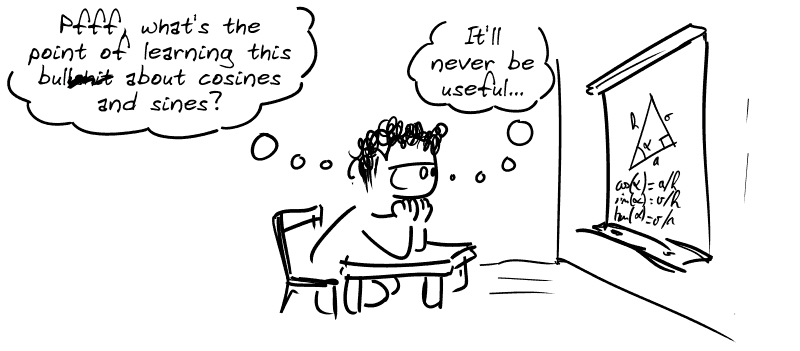
Well, actually, it will!
Especially when cutting a pie.
Hence the title of this article.
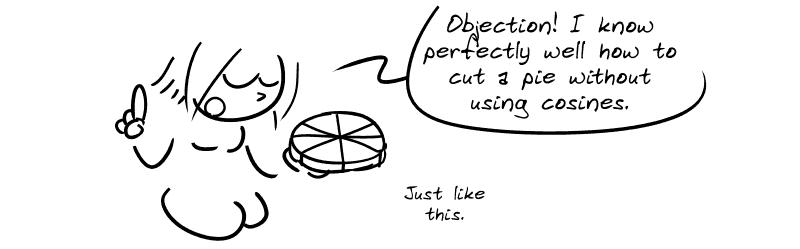
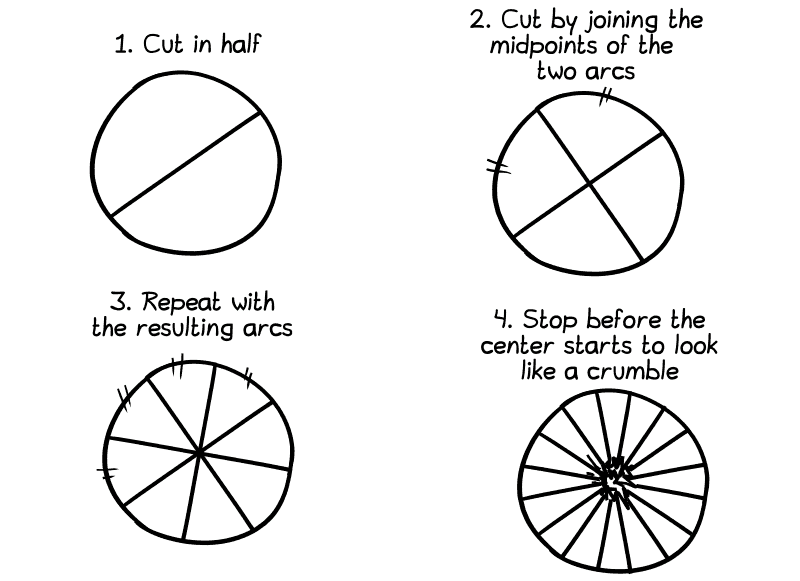
▶️ Obviously, cutting a pie into eight equal slices (and more generally, into powers of two, like 2, 4, 8, 16, etc.) is relatively simple and doesn't require trigonometry, just knowing how to aim roughly in the middle.
⚠️ But that's the easy part. No, we want to reach the next level, the ultimate way to cut a pie:
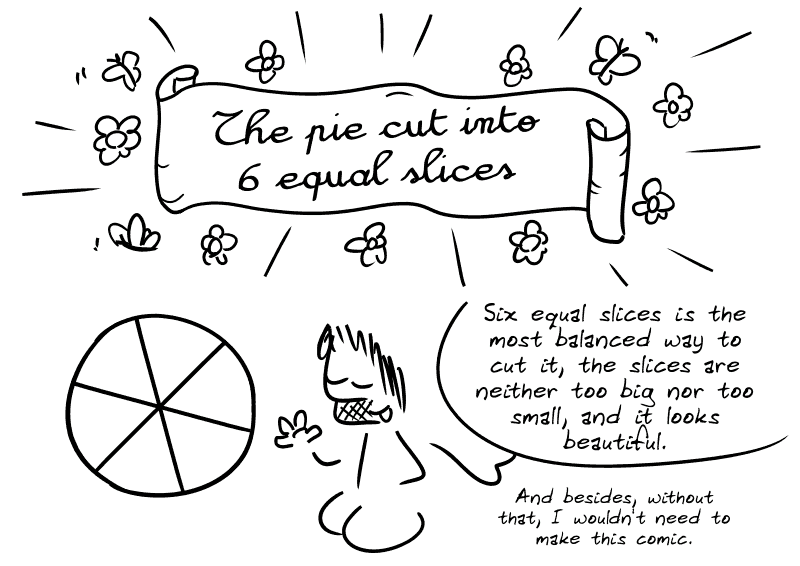
Anyway.
Cutting into six equal slices also starts with a straight cut through the center, but it poses a problem right from the second step.
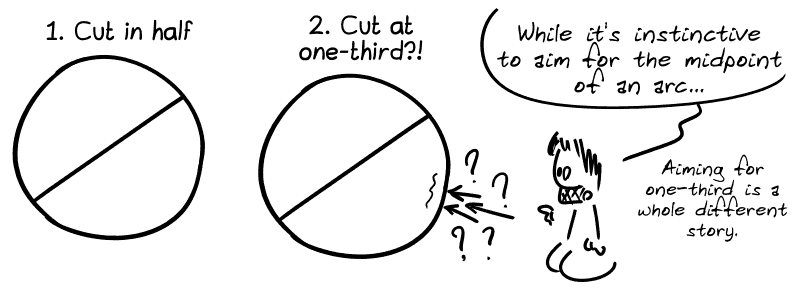
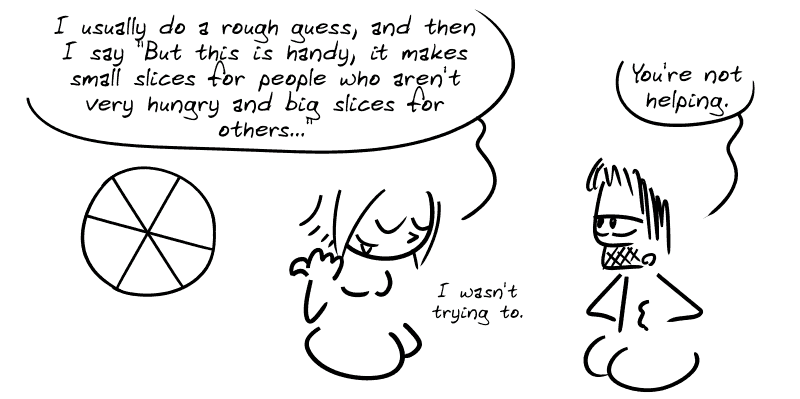
💡 So let's dust off our trigonometry lessons and talk specifically about the unit circle.
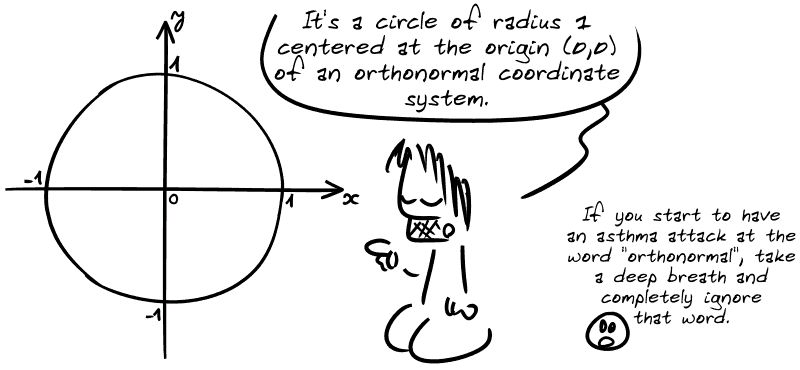
▶️ If we place a point on the circle, we can very easily determine the cosine and sine of the angle formed with the (0,x) axis.
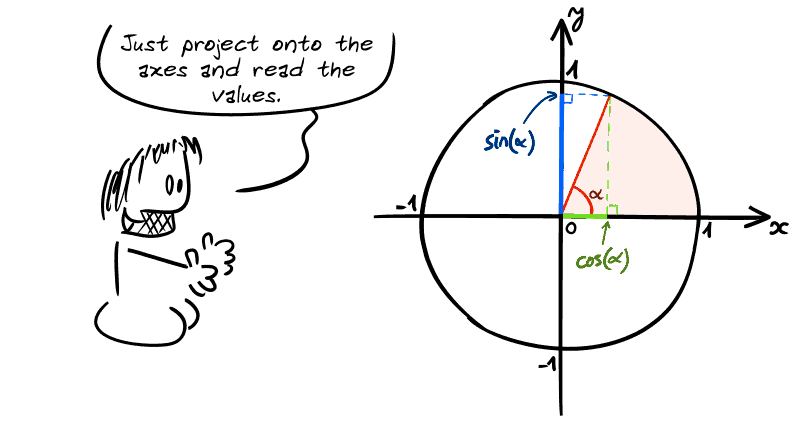
Some notable angles.
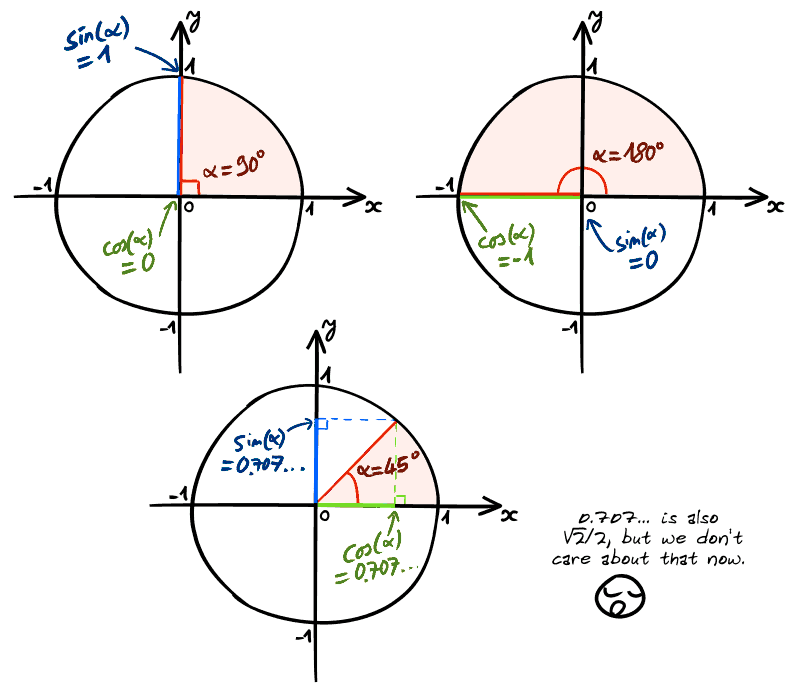
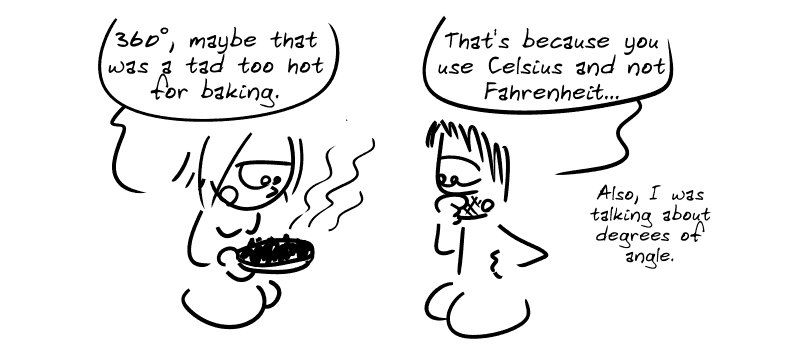
💡 What interests us in this case is how to easily find or position our knife for the second cut. The second cut must be at a 60° angle from the first (your pie is 360°, which gives 6 slices of 60° each).
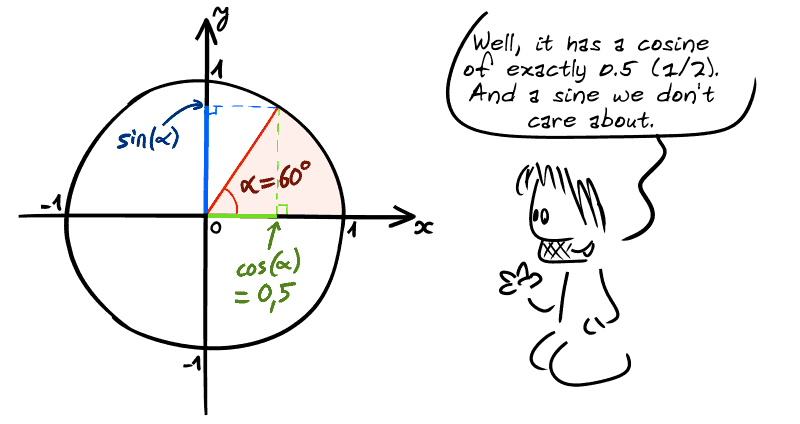
So, what does our trigonometric circle tell us about the 60° angle?
So now, after the theory, let's move on to the practical part.
Try to follow along, because this is going to get a little technical.
▶️ 1. Once you've made the first cut, find the midpoint of the cut, which corresponds to the center of the circle (by making a small mark with a knife, for example).
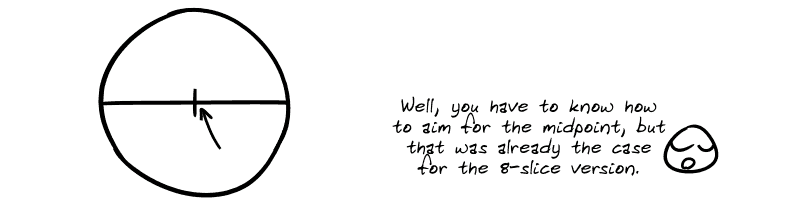
▶️ 2. Mark the midpoint of one of the two halves again.
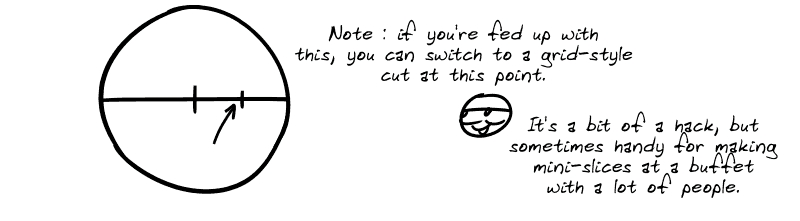
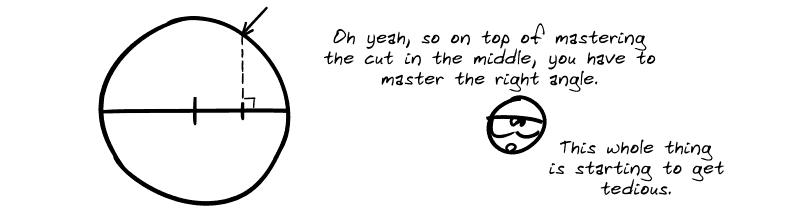
▶️ 3. Project this new point onto the edge of the slice.
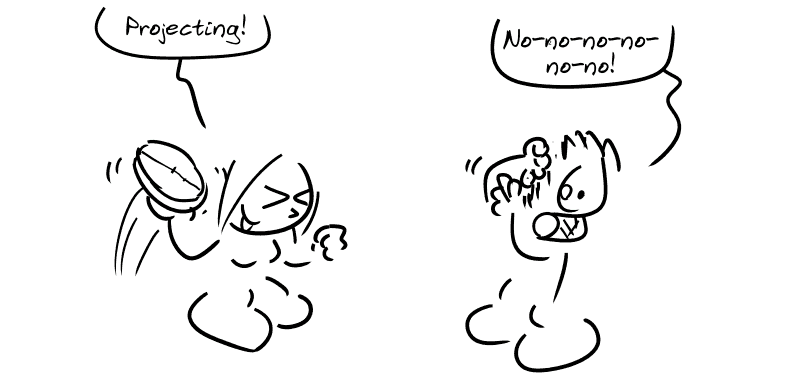
Note: to “project” draw a line at a right angle from the previous point until it intersects the edge.
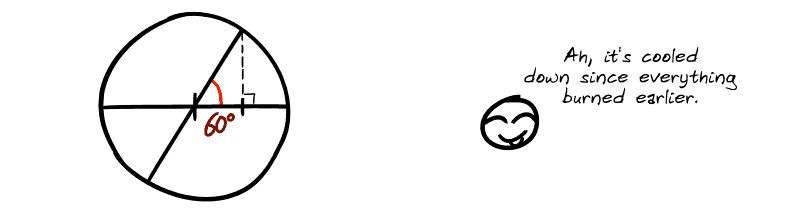
▶️ 4. Start from this new point to make your new cut, passing through the center. The resulting segment is exactly 60°!
▶️ 5. To finish up, you could do the same thing on the other side, but worst-case scenario, you just need to cut the large remaining arc in the middle, which, as we agreed, is relatively simple.
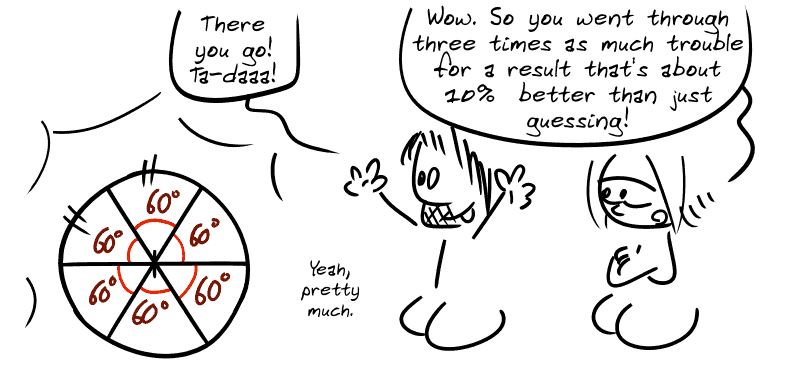
There you go.
Now you know how to cut a pie into six equal slices and impress everyone by explaining that you used a trigonometric circle and the fact that the cosine of 60° is exactly 0.5.
Don't thank me, I'm happy to help.

Comic strips that tackle a variety of topics —science, language, history, anecdotes— with humor while attempting to provide some educational added value: popular science, cultural or social analysis, etc.
Patrons
Grise Bouille is a free, open-source blog funded by its readers (you can support the blog too!). This post was made possible thanks to 50 wonderful patrons:
acryline • Caledfwuch • Thibault Lemaire • Elzen
PacMiam • ouille • Adri2 • ChrisD • wefoij234jfioew • LeGreg • Dersou • Pouhiou • Khyvodul • jomonbre • Teek36 • Mithril Informatique • Amic • Julian M. • Daarkmoon • Bookynette
kouinkouin • ScriptFanix • stph • BibiSky51 • Elpernouel • H²O • Thomas Citharel • dalan • Fabulous Fab’s • lamecarlate • junkbox • Ellute • psycho • Wipsy • JulienV • lsdog • Laurent • Guillaume • brab • 0sim0 • eenens • Yann TARDY • Tom Baumert • tuxayo • Keitjah • samulus • Martin Constantino–Bodin • Florent F • adorsaz • laedit
… and 63 others who are just as wonderful but wish to remain anonymous!
Related posts:

This blog uses no generative AI; the scenarios are not written by a computer program; the drawings are entirely hand-drawn on a graphic tablet by a human author-draftsman.
Support
This blog is published under a free license and may be freely copied, shared, modified, and reused. It is free of charge because supported by a monthly crowdfunding campaign. With no registration required, you can easily help unlock additional milestones:
For next month (December 2026), €570 has been raised, unlocking 4 out of 6 milestones:
Note: for more information, see the crowdfunding page.